Websites / Templates / Cleaning companies
A cleaning company website that books the first clean
People hiring cleaners care about trust and price in equal measure. This template shows hourly and fixed prices plainly, explains how cleaners are checked, and offers a re-clean promise.
From $1,499 + $69/month · live in under 7 days · we write every page for you
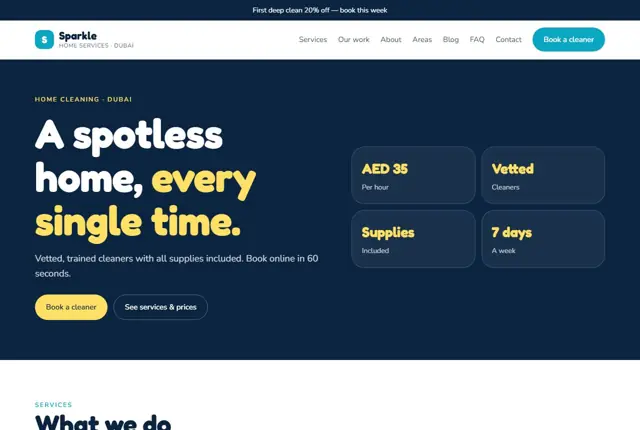
Choose your look
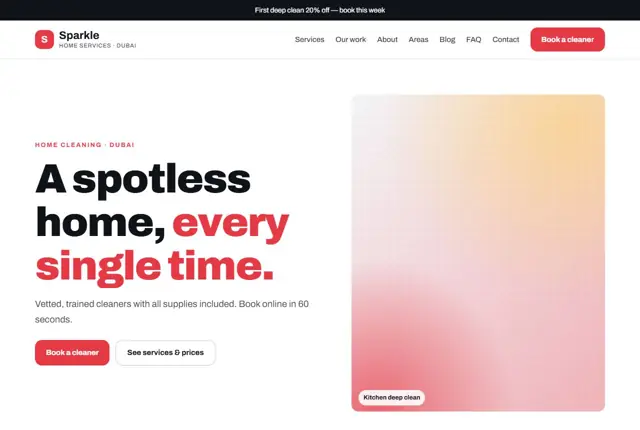
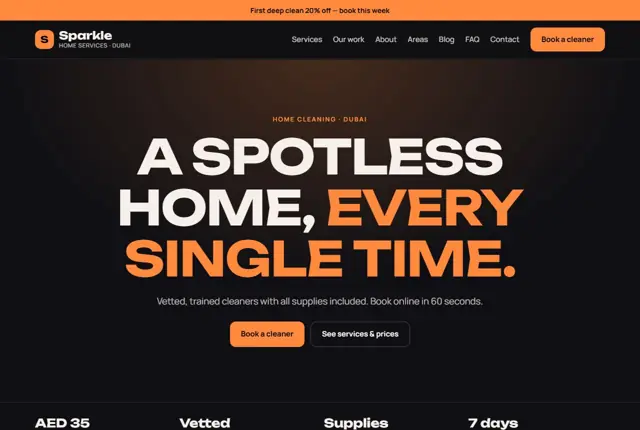
3 designs for your cleaning company
Same pages and words, three different styles. Pick one — or mix parts of them — and we match it to your colours and logo.
What your customers look for
Answer these before they ask
- Hourly rates and fixed-price deep cleans
- How cleaners are vetted
- Whether supplies are included
- Which areas you cover
Pages we build for you
Your cleaning company website, page by page
- Home with first-clean offer
- Regular cleaning
- Deep cleaning
- Move-in and move-out
- Areas covered
- Book a cleaner
FAQ, Contact and Privacy pages are free on every plan.
Free guide
How to plan a cleaning company website that wins regular clients
The pages a cleaning business needs
Start with one page per type of job: regular home cleaning, deep cleaning, end-of-tenancy, office cleaning and, if you do it, post-building cleans. Each page should say what is included, how long a typical visit takes and what the customer needs to provide. A short checklist of rooms and tasks removes most of the questions you would otherwise answer by phone.
Add an areas page that names every town or postcode district you serve, plus a quote page with a short form. Keep the form to postcode, property size, type of clean and a contact number. Long forms lose people who only wanted a rough price.
- Services
- Areas covered
- How it works
- About the team
- Get a quote
What a customer checks before letting you in their home
Someone hiring a cleaner is handing over their keys. They want to know who is coming, whether that person has been checked and what happens if something breaks. Say plainly how you recruit, whether staff are employed or self-employed, and whether you hold public liability insurance. In the UK, mention if cleaners have had a background check; in the US, say if you are bonded and insured.
Show pricing in a way that avoids surprises. A simple table of hourly rates, or fixed prices by number of bedrooms, lets people judge value in seconds. Say whether products and equipment are included, and say how you handle cancellations. Clear rules up front make first-time clients relaxed.
How people search for a cleaner
Most searches combine a service with a place: “end of tenancy cleaning Leeds”, “weekly house cleaner Austin” or “office cleaning Dubai Marina”. Use those exact patterns in page titles and headings, and mention neighbourhoods naturally in the text rather than stuffing a list at the bottom.
Many people also ask an assistant practical questions, such as how long a deep clean takes or what a landlord expects at checkout. Answer those on the relevant service page in two or three plain sentences. A page that explains the job clearly is easier to quote than one that only lists prices.
Recurring clients and the first visit
The best cleaning customers stay for years, so the site should lead people towards a repeat arrangement. Offer a clear choice between weekly, fortnightly and monthly visits, and explain that the same cleaner usually returns. Continuity is a real selling point, and customers value it more than a small discount.
Describe what happens on the first visit: a walk-through, a note of any rooms to skip, how you handle pets, and how the customer can give feedback afterwards. If you offer a re-clean when something is missed, say so in one sentence and show how to ask for it.
Getting found locally as a cleaning company
- Choose “House cleaning service” as the main Google Business Profile category and add “Carpet cleaning service” or “Office cleaning service” only if you really offer them.
- List your service area by town or postcode district instead of hiding your address if you work from home.
- Upload photos of your team in uniform, your equipment and finished rooms, with the customer’s permission.
- Ask for a review within a day of a successful first clean, while the home still looks good.
- Create a separate page for each district or city you cover, with a line about the streets and property types you know.
- Add yourself to trade directories and your local chamber of commerce, using the same name, address and phone number each time.
- Join a recognised trade association for cleaners in your country and show its badge only once membership is confirmed.
Mistakes to avoid
- Hiding prices completely, which makes shoppers assume the service is expensive and call a competitor who shows a number.
- Using stock photos of smiling models in spotless kitchens instead of your actual team, vehicle or equipment.
- Offering a single “contact us” page with no way to say what kind of clean is wanted, so every enquiry needs a callback.
- Saying “we cover the whole region” with no list of towns, which gives search engines and customers nothing to match.
- Forgetting to mention insurance and vetting, the two things nervous first-time clients look for.
Built in for cleaning companies
Features that matter in your industry
Price calculator-style tables
Vetting and insurance section
Area pages for each district
Found by Google — and recommended by AI
Tenants ask assistants “how do I get my deposit back after moving out”. A move-out page explaining what landlords check makes the company a natural recommendation.
Every Adyft site also ships with fast loading, structured data for search engines and a clear page for each service.
Questions
About websites for cleaning companies
Can customers book a regular clean?
Yes, the booking request lets them choose weekly or fortnightly; add online booking for a live calendar.
Can each area have a page?
On Growth and above, each district you cover gets its own page.
Can we show that cleaners are vetted?
Yes, a trust section explains your checks, training and insurance.
How much text should a cleaning website have?
Enough to answer the questions customers ask on the phone. Usually that means a few paragraphs per service, a price table and a list of areas. Pages do not need to be long, only clear.
Should I show prices or just offer quotes?
Show a starting price or a rate where you can. People who see a number come to you already comfortable with the cost, and you spend less time on calls with shoppers who were never going to book.
Can I take card payments or direct debits for regular clients?
Yes. Most cleaners collect payment through a separate payment or invoicing tool, and the website simply links to it. We can add that link to the booking page so regulars know how to pay.
Do I need separate pages for homes and offices?
Yes, because the two groups search differently and want different information. Homes care about trust and flexibility, offices about invoicing, out-of-hours access and contracts.
What photos should I supply?
Send a few of your team at work, your vehicle if it is branded, and before-and-after shots with the owner’s consent. Plain phone photos in good light are fine and often more convincing than stock images.
I already have a social media page. Why do I need a website?
A social page is hard to find through search and gives you no control over layout or message. A website is where someone lands from Google, sees your prices and areas, and sends a quote request in one tap.






Your cleaning company website, live this week.
Pick this design, answer a few questions on WhatsApp, and we build the rest.