Websites / Templates / Plumbers & heating engineers
A plumber website that turns emergencies into booked jobs
Nobody browses a plumber’s website at leisure — they arrive with water on the floor or a cold boiler. This template leads with a tap-to-call number, your call-out promise and a WhatsApp button for sending a photo of the problem.
From $1,499 + $69/month · live in under 7 days · we write every page for you

Choose your look
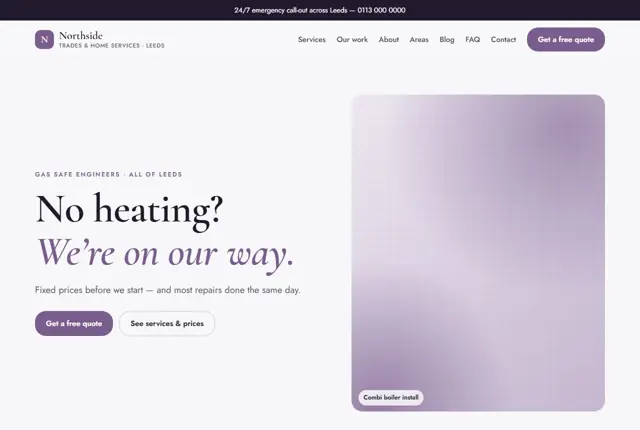
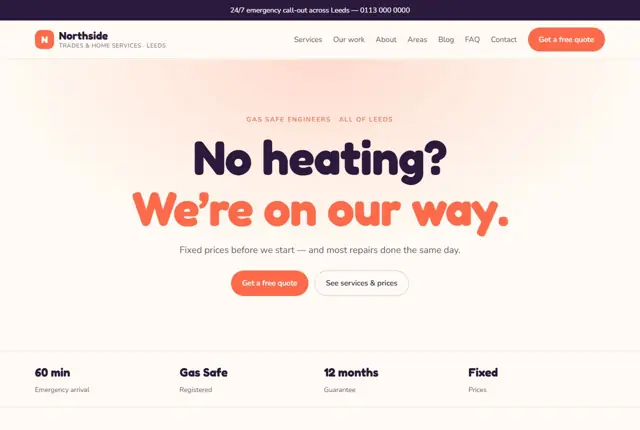
3 designs for your plumbing business
Same pages and words, three different styles. Pick one — or mix parts of them — and we match it to your colours and logo.
What your customers look for
Answer these before they ask
- A phone number they can tap within one second
- Whether you cover their street and how fast you arrive
- Rough prices so there are no surprises
- Proof you are registered and insured
Pages we build for you
Your plumbing business website, page by page
- Home with a 24/7 emergency banner
- Services with “from” prices
- Boiler, leak and bathroom pages (Growth plan)
- Area pages for each town you cover
- Reviews
- Free quote and contact
FAQ, Contact and Privacy pages are free on every plan.
Free guide
How to plan a plumber website that brings in calls
Which pages a plumbing website needs
Keep the structure simple. A home page states what you do, where you work and how to reach you. A services page splits the work into clear headings: leaks, boilers, radiators, bathrooms, drainage, and landlord checks if you do them. Each heavy-demand job, such as boiler repair or a new bathroom, deserves its own page with typical costs and timescales.
Add an “Areas we cover” page, and later one page per town. Add a gallery of finished jobs with short captions saying what was done. Finish with a contact page that offers a phone number, a WhatsApp number and a short form.
Each service page can follow the same simple order: the problem, what you do about it, what it usually costs, how long it takes, and how to book. That order matches the way a worried homeowner thinks, and it makes pages quick to write and easy to keep accurate.
- Home
- Boiler repair and servicing
- Emergency plumber
- Bathroom fitting
- Areas we cover
- Recent work
- Contact
What a homeowner checks before phoning
A person with a burst pipe wants speed. A person planning a new bathroom wants proof. The site has to serve both. Near the top, show your call-out hours and how quickly you usually arrive, without promising what you cannot keep.
Registration matters. In the UK, anyone working on gas appliances must be on the Gas Safe Register, so show your number and let visitors check it. Mention oil or heat-pump qualifications if you hold them, and state your public liability insurance. In other countries, name your local licence in the same way. Where you can, show a “from” price for common jobs, plus what a call-out fee covers.
Say what you do not do. If you do not fit kitchens or handle commercial boilers, say so politely. It saves wasted calls and makes the jobs you do take look more focused. A trusted name in a small area beats a vague promise to cover everything.
How people search for a plumber
Emergency searches are blunt: “plumber now”, “burst pipe help”, “no hot water”. Planned work is more detailed: “combi boiler replacement quote”, “bathroom fitter in Harrogate”. Write pages for both kinds, and keep emergency pages short, with the phone number repeated.
Questions to assistants sound like conversation: “who can fix a leaking radiator this afternoon?” An answer-first paragraph helps: say what you fix, the area, and how to book. Put the town name in headings and opening lines, because local intent drives most plumbing searches.
Think about the follow-up as well. After a quote, people often compare two or three firms. A page showing your guarantee, how you protect floors and furniture, and how you clean up can tip that decision when prices are close.
Handling emergencies and out-of-hours calls
If you offer emergency work, say how it works. Do you answer all night, or only until ten? Is there a higher out-of-hours rate? Visitors accept a premium when it is stated upfront and resent it when it appears on the invoice.
Give a few safe first steps: where the stopcock usually is, how to switch off a boiler, when to leave the property and call the gas emergency number. This small block is useful, gets quoted often, and shows you know the work. Make sure the call button stays visible as people scroll on a phone.
Landlords and letting agents are valuable repeat clients. A short page for them, covering safety certificates, response times for tenant call-outs and invoicing, can bring steady work and be found by people searching in that specific way.
Getting found locally as a plumber
- Pick “Plumber” as your main Google Business Profile category and add “Heating contractor” or “Boiler repair service” if they apply.
- Set your service area by town rather than showing a home address, if you work from home.
- Post photos of real jobs: before, during and after, with the town named in the caption.
- Ask each happy customer for a review before you pack up, while the problem is still fresh in their mind.
- Join the directories your trade body provides, and add your registration number to each listing.
- Keep your business name, phone number and area wording the same everywhere it appears online.
- Create a short page for each town you serve, with local details such as common housing types or hard-water areas.
- Update opening hours for bank holidays so Google does not show you closed when you are available.
Mistakes to avoid
- Putting a contact form only, with no phone number a person can tap.
- Listing “all of the county” as a service area, instead of naming the towns you truly reach.
- Showing stock photos of smiling workers in clean uniforms rather than your own van and jobs.
- Claiming Gas Safe status without a visible number, or with an expired one.
- Skipping prices entirely, so customers assume the cheapest rival is the safer choice.
Built in for plumbers & heating engineers
Features that matter in your industry
“Send us a photo” WhatsApp button for faster quotes
Registration and insurance badges in the header area
Area pages that match how people search, like “plumber in Horsforth”
Found by Google — and recommended by AI
Assistants answering “who can fix my boiler today” favour businesses that state their coverage area, response time and registration clearly. Each area page names the town and the services available there.
Every Adyft site also ships with fast loading, structured data for search engines and a clear page for each service.
Questions
About websites for plumbers & heating engineers
Do you write a page for every town I cover?
On Growth and above, yes — each area gets its own page, so local searches find the right one.
Can customers send me photos?
Yes. The WhatsApp button lets them send a photo of the leak or boiler fault before you quote.
Can it show my Gas Safe number?
Yes, we add your registration and insurance details where customers look for them.
How quickly can a new plumbing site be live?
Starter sites are live in under 7 days once you have approved the wording. Emergency details and your coverage areas are the first items we confirm with you.
Do I need to own a domain already?
No. If you do not have one, we help you pick a short, clear name that includes your trade or town. If you do own one, we connect it.
Can I show different prices for emergency and normal hours?
Yes. We can set out both rates clearly, so customers know what to expect before they call.
What if I take on a new service later, such as heat pumps?
Tell us on WhatsApp and we add it as part of your monthly changes, with a dedicated page on Growth and above.
Can customers book a slot without phoning?
A WhatsApp button covers most small firms. If you want a calendar, an online booking add-on can be added.
Will the site work well on a phone?
Yes. Most plumbing searches happen on a phone, so every page is designed for small screens first, with the call button always in reach.





Your plumbing business website, live this week.
Pick this design, answer a few questions on WhatsApp, and we build the rest.