Websites / Templates / Interior designers & architects
An interior design website that shows how you think
Clients hire a designer for their taste and their process. This template gives each project room to breathe, then explains what working together involves, from a single room to a full renovation.
From $1,499 + $69/month · live in under 7 days · we write every page for you
Choose your look
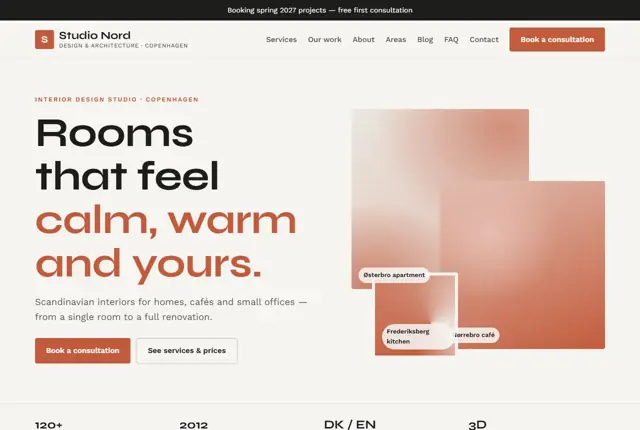
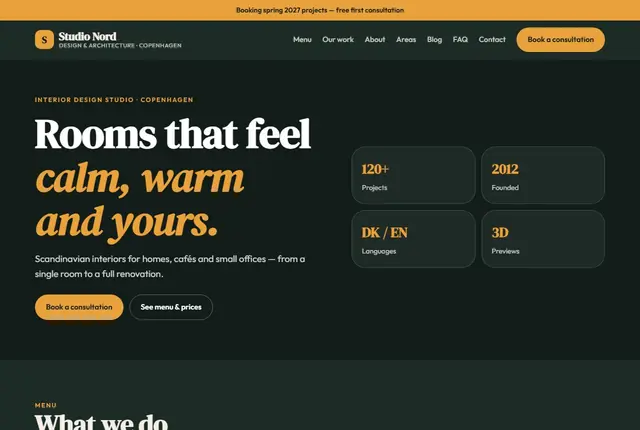
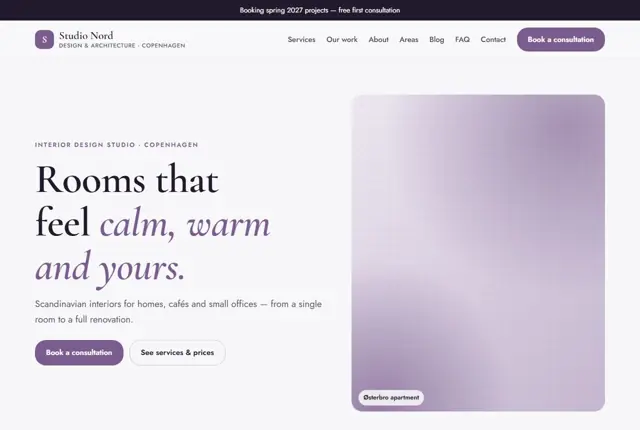
3 designs for your design studio
Same pages and words, three different styles. Pick one — or mix parts of them — and we match it to your colours and logo.
What your customers look for
Answer these before they ask
- Finished projects similar to their home or business
- Service levels and how fees work
- How long a project takes
- Whether you work remotely
Pages we build for you
Your design studio website, page by page
- Home with featured projects
- Services and fees
- Project pages
- Studio and team
- Journal
- Book a consultation
FAQ, Contact and Privacy pages are free on every plan.
Free guide
How to plan an interior designer’s website that attracts real projects
Pages that show how you work
Remember that most visitors are not looking at the site as designers. They are comparing you with two or three other studios, so use the same simple order on every project page: brief, challenge, solution, result. That makes it easy to compare and easy to remember.
Clients rarely hire an interior designer from a single photo. They want to see a project, understand the process and picture working with you. Begin with a home page led by one finished room, a sentence about the kind of homes or businesses you design and a clear consultation button.
The most valuable pages are individual Project pages. Each one should show the brief, the problems you solved, the before-and-after where possible, and a short note about budget range or timeline. Add a Services page that separates full design, a room refresh, styling and sourcing, plus a Process page, an About page and a Contact page.
- Home with a featured project
- Projects, one page each
- Services and levels of involvement
- Process from first call to handover
- About the studio
- Book a consultation
What clients need to know before reaching out
Hiring a designer is a big step, and clients worry about cost and losing control. Explain how you charge: a fixed design fee, an hourly rate, a percentage of the build or a mix. Even a “from” figure helps filter enquiries. Describe how you handle contractors, suppliers and delays, and who is in the room when decisions are made.
Be clear about what you do not do. Some studios design only; others manage the whole build. Say if you work with a regular team of builders or can work with the client’s own. Mention insurance and any professional membership you hold, such as a recognised design association in your country. Include realistic timelines so clients know that good design takes months, not days.
How clients search for a designer
Many clients start with pictures and only later look for a person. Give every image a clear caption, and add a line saying what the room is and where it is, so that image search and assistants can connect pictures to your studio.
Searches usually pair a room or style with a place: “kitchen designer in Surrey”, “Scandinavian interior designer London”, “villa interior design Dubai”, “home office design near me”. Others ask assistants how to hire a designer or how much a full-home project costs.
Name your style honestly and in ordinary words, such as warm modern, classic, minimalist or family-friendly. Add the area to your service description and write project titles that include the type of property and place. Each project page should read like a short story, not a list of materials. A caption such as “a narrow Victorian terrace opened up to let in light” helps people searching for that exact situation.
Showing photography and handling remote work
Do not forget the first call. Say what happens during it, how long it lasts and whether it is free or paid. Clients who know what to expect are more likely to book it.
Interior photography is your shop window, so use real photos of finished spaces and avoid mixing in renders without saying so. Credit the photographer. If you only have a few completed projects, show quality over quantity and add concept boards to explain your thinking.
Many clients now work with designers from a different city or country. If you offer remote design, create a page that explains how it works: measured plans from the client, video calls, shopping lists and delivery coordination. Say which regions you serve and how you handle site visits. This widens your reach without forcing you to travel for every enquiry.
Getting found locally as an interior designer
- Choose Interior designer as the main Google Business Profile category and add Home staging service if you offer it.
- Upload your best project photos to the profile and caption each with the type of space.
- Ask clients for a review once the final photos are taken and they are enjoying the finished space.
- Write a project page for every neighbourhood where you have completed work.
- List your studio in directories run by design associations, showrooms and trade suppliers you buy from.
- Ask builders, architects and estate agents you work with to link to your site.
- Keep your studio name, address and phone number the same across every profile.
Mistakes to avoid
- Showing only polished close-ups, so clients cannot judge a whole room or the layout.
- Never mentioning fees or budget range, which leads to unsuitable enquiries.
- Mixing concept renders with finished photos without explaining which is which.
- Using vague phrases like “bespoke luxury” without saying what you actually do.
- Having a contact form with no information about what to include in the first message.
Built in for interior designers & architects
Features that matter in your industry
Case-study pages with the brief, approach and result
Service levels compared clearly
Virtual-design option for remote clients
Found by Google — and recommended by AI
Assistants asked for “Scandinavian interior designer for a small apartment” look for portfolios described in words, not only pictures. Each project page here describes the space, style and solution.
Every Adyft site also ships with fast loading, structured data for search engines and a clear page for each service.
Questions
About websites for interior designers & architects
Can each project have its own page?
Yes — on Growth and above, every project becomes a case study.
Can we explain our fees?
Yes, as fixed design fees or starting prices per service level.
Can clients outside our city find us?
A virtual-design section and clear service area help clients further away.
How many projects do I need before launching?
Three to five well-photographed projects are enough to start. Add new ones as you finish them, with a short story about the brief and the result.
Can I show prices on an interior design site?
You can show how you charge and a starting figure for each service. Many studios avoid exact quotes but still give a range so the right clients get in touch.
Should I include client names?
Only with permission. You can describe a project by property type and area, like “three-bedroom flat in Manchester”, without naming the family.
Can I link my site to Pinterest or Instagram?
Yes. Social links can sit in the footer, and we can show a small selection of images, though the main portfolio stays on your own site.
What about copyright on photos?
Check your agreement with the photographer for web use and credit them on the page. We can add the credit alongside each image.
Can clients book a paid consultation online?
Yes. The Book button can link to your calendar or payment link, or collect a request first so you can confirm fit before taking payment.






Your design studio website, live this week.
Pick this design, answer a few questions on WhatsApp, and we build the rest.