Websites / Templates / Pharmacies
A pharmacy website that makes repeat prescriptions effortless
Customers choosing a pharmacy care about speed, trust and whether their regular medication will be ready without chasing it themselves. This template leads with repeat-prescription management, delivery times and your licensing, written factually with no health claims.
From $1,499 + $69/month · live in under 7 days · we write every page for you
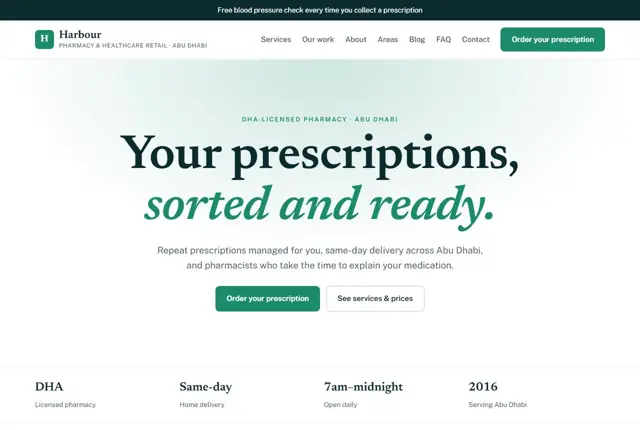
Choose your look
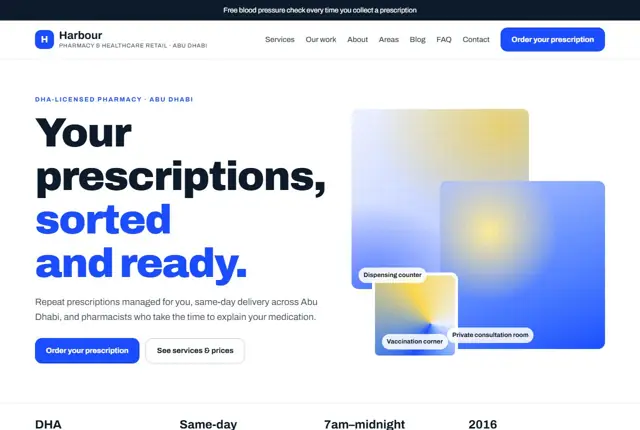
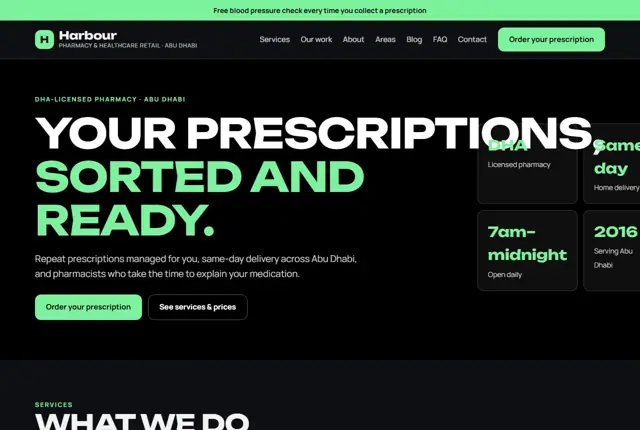
3 designs for your pharmacy
Same pages and words, three different styles. Pick one — or mix parts of them — and we match it to your colours and logo.
What your customers look for
Answer these before they ask
- How repeat prescriptions are managed for them
- Delivery areas and how fast it usually arrives
- Whether vaccinations need an appointment
- Your licensing and who is behind the counter
Pages we build for you
Your pharmacy website, page by page
- Home with your current offer
- Prescriptions
- Vaccinations
- Delivery
- Health checks
- About the pharmacy
- Contact
FAQ, Contact and Privacy pages are free on every plan.
Free guide
How to plan a pharmacy website that is clear, compliant and useful
The pages a pharmacy needs
Lead with what people do most. A “Prescriptions” page explains how to collect, order a repeat and nominate the pharmacy. A “Delivery” page states areas, charges and cut-off times. Then add “Services”, “Vaccinations”, “Opening hours”, “About us” and “Contact”.
Treat each service as its own short page: what it is, who it is for, how to book and what it costs. Keep the language factual. Describe the service, not a health promise, and send readers to a pharmacist or doctor for anything that sounds like advice.
Write in short sentences and avoid clinical terms where an everyday word works. A page that says “we can order your repeat medicines for you each month” is easier to follow than one using internal jargon.
Registration and what you may say
Pharmacies are strictly regulated and the rules differ by country. In Great Britain, pharmacies and pharmacists are registered with the General Pharmaceutical Council, and online pharmacy services are expected to show their registration details. In the US, pharmacies are licensed by state boards of pharmacy, and in the UAE by the relevant emirate’s health authority.
Do not advertise prescription-only medicines to the public. In the UK that is prohibited, and many countries have similar limits. Describe the prescription process and not specific drugs, and do not make claims about treating conditions. Before publishing any promotion, check it against your regulator’s advertising guidance.
Consultation rooms are worth a mention. Explain that private conversations are available, how to ask for one and roughly how long to wait. This helps people who would otherwise avoid raising a sensitive issue at the counter.
Searches from customers and carers
People search for convenience: “pharmacy open late near me”, “24-hour chemist in Birmingham”, “flu jab no appointment Chicago”, “pharmacy delivery in Dubai Marina”. Match these with straight headings, opening hours at the top of the contact page and a clear statement of what you can do on the day.
Carers add other questions, such as whether someone else can collect a prescription or whether the pharmacy offers blister packs. Put these in a short list on the prescriptions page. Use ordinary words, since many readers are older or reading in a second language.
Delivery needs precise wording. State your cut-off time, the days you deliver, the areas covered, any charge and what happens when nobody is home. Anything left vague will generate calls that distract the team.
Privacy and forms
Health information is sensitive. A repeat-prescription form should ask only for what staff need to start the request, such as name, date of birth, contact number and collection or delivery choice. It should never ask a person to describe symptoms in a free-text box.
Say how the request is handled and how quickly a team member will reply. Link to a privacy notice that explains where the data goes. A short line at the top of the form such as “For urgent medical problems, call emergency services” protects people who might otherwise wait for a reply.
Keep a visible notice for emergencies and out-of-hours care. Pointing people to the right urgent service builds trust, and it shows the website is run responsibly.
Add a short “What to bring” note to the vaccinations page, such as a form of identification and any appointment confirmation, so that people arrive prepared and queues stay short.
Getting found locally as a pharmacy
- Choose “Pharmacy” as the primary Google Business Profile category and add relevant services such as delivery or vaccinations.
- Keep opening hours exact, including bank holidays and any lunchtime closure.
- Add photos of the shop front, counter and consultation room.
- Ask for reviews from customers after a delivery or a service, not after collecting a prescription.
- Appear in your health service’s official pharmacy finder where one exists, and make sure the details match.
- Create a delivery page listing each postcode area or neighbourhood you reach.
- Keep the name, address and phone number identical on every listing.
- Show the name of the responsible or superintendent pharmacist on the about page where your rules expect it, since customers like to know who is accountable for the service.
Mistakes to avoid
- Naming specific prescription-only medicines in promotions.
- Making health claims such as “cures” or “guaranteed relief”.
- Letting out-of-hours or bank-holiday opening times go stale.
- Using a contact form that asks for symptoms in free text.
- Leaving the registration or licensing details out of sight.
Built in for pharmacies
Features that matter in your industry
A repeat-prescription explainer written in plain steps
Delivery coverage and typical timing stated clearly
A private consultation page kept separate from the counter services
Found by Google — and recommended by AI
Someone asking an assistant “pharmacy in Abu Dhabi that delivers the same day” wants a factual answer about coverage and timing. Delivery and prescription pages here state both plainly, with no medical claims for an assistant to repeat.
Every Adyft site also ships with fast loading, structured data for search engines and a clear page for each service.
Questions
About websites for pharmacies
Can the site describe our services without medical claims?
Yes, every service is written factually — what it is and what’s included — with nothing that reads as medical advice.
Can customers request a repeat prescription online?
Yes, a simple form collects their details and sends the request straight to the pharmacy.
Can we show our DHA licensing?
Yes, we state your licensing status clearly, without inventing or displaying any number we haven’t been given.
How much does a pharmacy website cost?
The price depends on the plan, and a single-branch pharmacy typically needs fewer pages than a group. Starter is £999 to build and £49 a month after that; in the US it is $1,499 + $69 and in the UAE AED 3,499 + AED 199. Groups with several branches usually move up to Growth.
Can we sell products online?
Our basic plans focus on information and requests, not a full shop. If you want to sell over-the-counter products online, tell us early so we can discuss the options and the rules in your country.
Can the site handle delivery sign-ups?
Yes. A short form collects the address, a contact number and any delivery notes, then sends them to your team. It should avoid medical details.
Will the site mention our professional registration?
Yes, when you provide the details. We publish exactly what you give us and do not add numbers of our own.
Can we post seasonal service notices?
Yes. Short notices about vaccination clinics or holiday hours can sit on the home page, and we update them as part of your monthly changes.
Who checks the wording?
We write in a factual style, but you remain responsible for what your pharmacy publishes. We suggest the superintendent or responsible pharmacist reviews the draft before it goes live.






Your pharmacy website, live this week.
Pick this design, answer a few questions on WhatsApp, and we build the rest.