Websites / Templates / Estate agents & property
An estate agent website that wins the valuation
Sellers choose an agent they believe knows their area best. This template is built around that: community pages, a valuation request on every page, and clear fees, with listings linked from the portals you already use.
From $1,499 + $69/month · live in under 7 days · we write every page for you
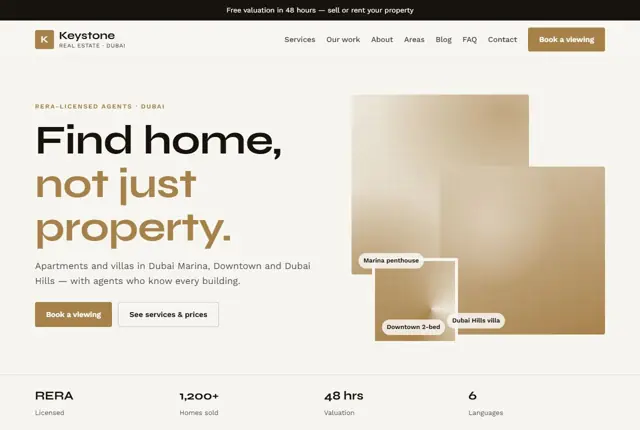
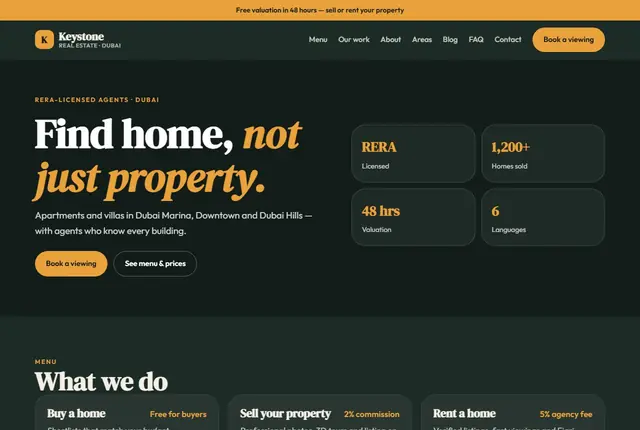
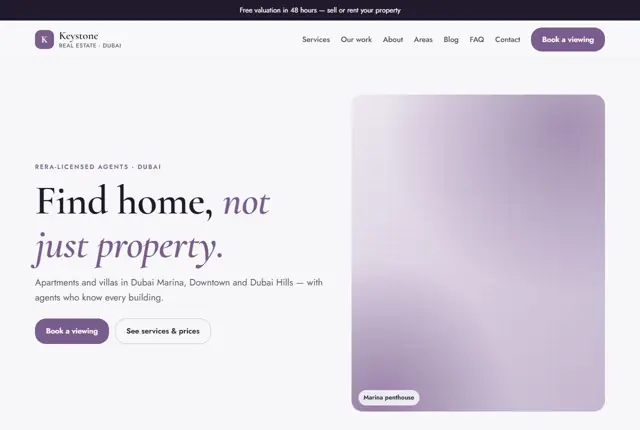
Choose your look
3 designs for your estate agency
Same pages and words, three different styles. Pick one — or mix parts of them — and we match it to your colours and logo.
What your customers look for
Answer these before they ask
- How well you know their building or street
- Your fees and what they include
- How quickly you can value and market a home
- Whether you speak their language
Pages we build for you
Your estate agency website, page by page
- Home with free valuation offer
- Buy, sell, rent and manage
- Community guides for each area
- Meet the agents
- Sold examples
- Book a valuation
FAQ, Contact and Privacy pages are free on every plan.
Free guide
How to plan an estate agency website that wins valuations and listings
The pages an estate agency site depends on
Think of the site in two halves: one for sellers and landlords, one for buyers and tenants. The seller half needs a valuation page, a “how we market your home” page, a fees page and examples of recent sales. The buyer half needs search or links to your listings, a registration page for alerts, and a guide to the buying process.
Add a page for each neighbourhood you work in, a team page with photos and areas of expertise, and a contact page for each branch. If you manage rentals, a landlord page covering tenant checks, rent collection and maintenance helps to bring in new instructions.
Write each agent profile around what the person actually does: the areas they know best, the languages they speak, and the types of home they usually handle. Avoid empty slogans. A seller reading a profile should be able to picture the first phone call.
- Book a valuation
- Selling with us
- Landlords
- Area guides
- Recent sales
- Our team
- Branch contact
What sellers and landlords check before choosing
A seller is choosing an adviser to handle their biggest asset. They look for local knowledge, a track record and a fee they understand. Show how your fee is calculated, what is included and whether there are exit charges. Name the property redress scheme or professional body you belong to, if you do, and show your registration number where your country requires one.
Recent results help. Describe homes you sold, the asking price against the final price, and how long the sale took, using only facts you can prove. Photographs of the team and a short note on who will personally handle the sale help the owner picture working with you.
Offer a small set of helpful guides: preparing a home for sale, understanding energy or condition reports, what happens between offer and completion, and what landlords must provide. Practical help earns trust long before anyone is ready to instruct you.
How buyers and sellers search for property help
Sellers search for “estate agents in Altrincham”, “how much is my house worth” and “sell my flat quickly”. Renters search for “2 bed to rent in Jumeirah”. Landlords ask for “letting agent that handles repairs”. Match these with clear page titles and headings that use both the service and the place.
Area guides are valuable here. Describe schools, transport, typical property types and the feel of each district. Assistants often answer “is this a good area for young families?”, and a careful, honest guide can be a source for them. Avoid empty praise: mention the downsides too, as readers trust balanced writing.
Be careful with claims. Phrases like “the best agent in town” cannot be proved and may breach advertising rules. Show facts instead: homes sold last year, average time on the market if you track it, or the number of years you have worked the area.
Valuation requests, listings and portals
Most agents rely on property portals for listings. Your own site should not try to compete with them on volume. Instead, link to your live listings and use the site to win the next instruction. Make the valuation request short: address, name, phone and best time to call.
Respond fast. A request left for a day often goes to a competitor. Explain what happens after the form: a call, a visit and a written appraisal within a stated time. Make sure the details you advertise, such as fees and opening hours, match what is on the portals, since mismatches create doubt.
For lettings, spell out how you screen tenants, handle deposits and arrange repairs. Landlords are reassured by detail, and tenants appreciate knowing the process. A short checklist on each page keeps the information easy to scan.
Getting found locally as an estate agency
- Choose “Real estate agency” as the primary Google Business Profile category and add “Letting agent” if you do lettings.
- Create a separate profile for each branch with its own address, hours and local phone number.
- Post photos of your office, your team and “sold” boards in the neighbourhoods you serve.
- Ask vendors and landlords for a review once a sale completes or a tenancy starts well.
- Join the professional bodies and redress schemes that apply in your country and display the badges.
- Publish a guide for each neighbourhood you cover, with local facts that residents recognise.
- Keep your agency name, address and phone number identical on the portals and your own site.
Mistakes to avoid
- Copying the same generic area text onto every district page.
- Making the valuation form long, so sellers abandon it.
- Leaving out fees, which makes the agency look expensive or evasive.
- Showing outdated sold prices or listings that are no longer available.
- Ignoring the lettings side when landlords make up much of the potential business.
Built in for estate agents & property
Features that matter in your industry
Valuation request form on every page
Community guides that build local search presence
Agent profiles with areas and languages
Found by Google — and recommended by AI
Buyers ask assistants things like “which areas of Dubai are best for families renting a 2-bed”. Community guides here describe each area honestly, so the agency is the source an assistant can cite.
Every Adyft site also ships with fast loading, structured data for search engines and a clear page for each service.
Questions
About websites for estate agents & property
Can we show live listings?
We link to your portal listings or embed a feed; the website focuses on winning valuations and enquiries.
Can each community have a page?
Yes — on Growth and above, each area gets its own guide.
Can it work in more than one language?
Yes, the Scale plan adds a second language version.
How do you write area guides without copying others?
We write each guide from details you give us about the area, then add practical facts for residents. Every guide is unique and approved by you.
Can the site show my live listings?
We link to your portal listings or embed a feed, and use the site itself to win valuations and enquiries.
Can each branch have its own page?
Yes. Each branch can have a page with its address, map, team and opening hours.
Can I add a mortgage or relocation page?
Yes. If you work with partners on mortgages or relocation, we can write a page that explains the service and shows how to contact them.
What about legal wording and fees?
We include the wording your country requires, such as registration details and a clear fee description, for you to approve.
How soon will the site bring valuation requests?
The site goes live in under 7 days on Starter. Search visibility grows over weeks, so the valuation form and WhatsApp button are placed to convert the visitors you already have.






Your estate agency website, live this week.
Pick this design, answer a few questions on WhatsApp, and we build the rest.