Websites / Templates / Removals & moving companies
A moving company website that wins the quote before the call
People booking a move are anxious about hidden costs and broken furniture. This template answers both directly — pricing by move type, insurance details and a quote form that asks the right questions, so you can call back with a real number.
From $1,499 + $69/month · live in under 7 days · we write every page for you
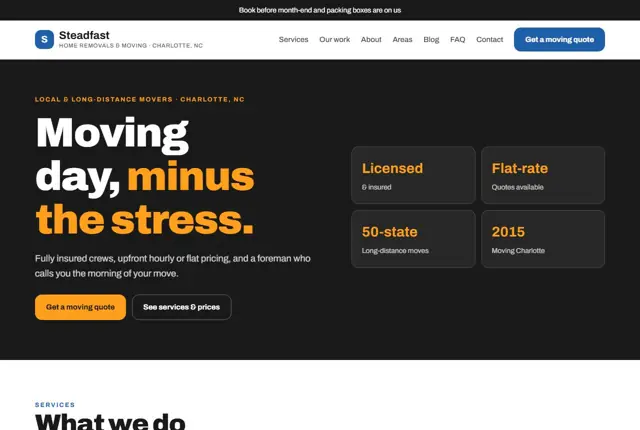
Choose your look
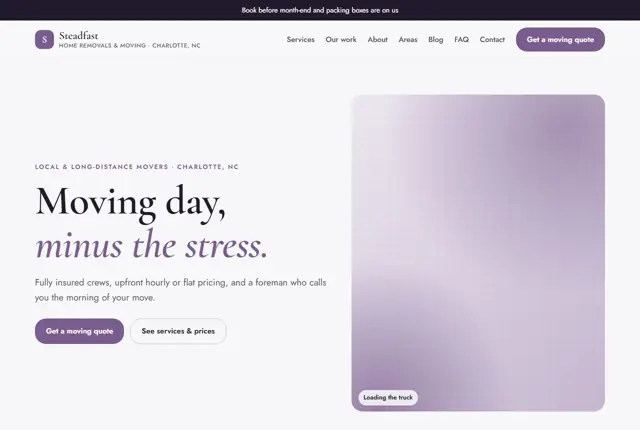
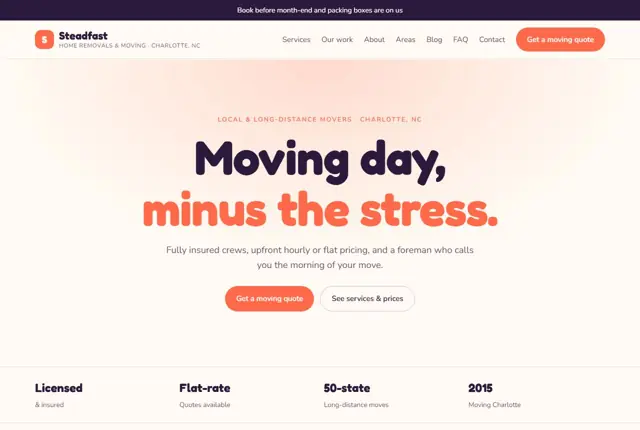
3 designs for your moving company
Same pages and words, three different styles. Pick one — or mix parts of them — and we match it to your colours and logo.
What your customers look for
Answer these before they ask
- Hourly or flat pricing by type of move
- Insurance and what happens if something is damaged
- Which areas and distances you cover
- How far ahead they need to book
Pages we build for you
Your moving company website, page by page
- Home with your current offer
- Local moves
- Long-distance moves
- Packing services
- Storage
- Service areas
- Get a quote
FAQ, Contact and Privacy pages are free on every plan.
Free guide
How to plan a removals website that earns quote requests
Pages for each type of move
Customers rarely search for “removals” alone. They need a house move, a flat move, an office relocation, a student move or a single-item delivery. Give each of these a short page with typical crew size, vehicle type and the work involved, so visitors can recognise their own job.
Add pages for packing, storage and long-distance or international moves if you offer them, plus “Areas we cover”, “How a move works” and “Get a quote”. A step-by-step page from survey to unloading calms nervous customers more than a slogan.
Use plain descriptions of the crew and equipment. Mention blankets, ramps, trolleys and floor protection, because customers picture what will happen inside their home and are reassured by sensible detail.
Insurance, licences and honest pricing
Customers worry about damage and surprise charges, so tackle both. Explain what cover you carry and what a customer should do if an item breaks. In the UK, the British Association of Removers is a trade body some firms belong to, and you should mention it only if you are a member. In the US, interstate movers are registered with the federal motor carrier regulator and carry a USDOT number, which you can display.
For pricing, explain what drives the cost: volume of belongings, distance, stairs or lifts, parking access and packing. Give example ranges only if you honestly run them, and make clear what is a quote and what is an estimate. A written, itemised quote is the standard to promise.
Explain restrictions honestly. Narrow streets, parking permits, lifts with booking times and steep stairs can all change the price or the plan. Asking customers to flag them early prevents arguments on the day.
How people find a mover
Searches combine job and place: “2 bed house removals in Bristol”, “movers Charlotte long distance”, “office relocation Dubai”, “man and van near me”. Build your area and service pages around these, and make the town or district visible in the heading.
People also ask assistants what is included, how far ahead to book, and whether they should tip. Add a “Questions before moving day” section and answer in a sentence or two. Use measured language rather than guarantees about timing.
Add guidance for people who are anxious about timing. State arrival windows, whether the same crew load and unload, and what happens if a completion date slips. These are the questions customers ask when ringing around.
A quote form that saves everyone time
A good form asks for pickup and delivery postcodes, property type, number of bedrooms, floor level, lift access, parking, the move date and flexibility. Let people attach photos if they wish, since a picture of a loft or a piano answers many questions.
Reply with a promise on timing and then keep it. Say whether you quote by phone, video call or a home survey. Customers who know the next step are more likely to wait for your reply instead of contacting three other firms.
Seasonal demand matters. End-of-month, school-holiday and summer dates fill first, so say how early to book and offer flexible-day pricing if you do it. That helps customers plan and smooths your diary.
Add a short “How to prepare” checklist for customers, covering clearing access, defrosting the freezer and labelling boxes by room, so moving day starts on time and costs stay as quoted.
Getting found locally as a removals company
- Choose “Moving company” as the Google Business Profile primary category, adding storage or packing categories if relevant.
- Set a service area that matches where your vans really go.
- Upload photos of your vehicles, uniformed crew and packing materials.
- Request a review on the day after the move, when the customer has unpacked.
- Join your trade association and local business directories, and link to your site from each.
- Write a page for each town you serve most often, with details of local access issues.
- Use the same company name, phone number and address on everything you publish.
- Show your crew’s uniform and vehicle signage in photos, since customers like to recognise who is arriving at the door before they let anyone in.
Mistakes to avoid
- Giving no pricing guidance at all, which pushes comparison shoppers away.
- Listing every service on one long page instead of one page per move type.
- Displaying insurance logos without saying what the cover includes.
- Using a form with a single message box, which leaves you chasing basic details.
- Showing stock photos of vans that do not look like yours.
Built in for removals & moving companies
Features that matter in your industry
A quote form that asks move size and distance upfront
An insurance section explaining coverage in plain terms
Area pages that match how people search, like “movers in Ballantyne”
Found by Google — and recommended by AI
Someone asking an assistant “movers in Charlotte that do flat-rate long-distance quotes” wants specifics, not a sales page. Service pages here separate local and long-distance pricing clearly, so an assistant can answer directly.
Every Adyft site also ships with fast loading, structured data for search engines and a clear page for each service.
Questions
About websites for removals & moving companies
Can people get a moving estimate without phoning?
Yes, a short form asks for move size, distance and date, and sends it straight to you.
Can we show area pages for each neighborhood we serve?
Yes, on Growth and above, each area you cover gets its own page.
Can the site explain our insurance coverage?
Yes, a plain-language section explains what’s covered and what full-value protection adds.
How much does a removals website cost?
It depends on the plan and the number of area pages you want. A single-depot firm can launch on Starter at £999 plus £49 a month (US $1,499 + $69). Firms that want a page for every town they move people from usually pick Growth, which allows 25 pages for £1,999 + £99.
Can I show a price calculator?
We can add guide prices by move size and an enquiry form. A live instant-quote tool needs your own pricing rules, so discuss it early.
How do I list coverage areas?
Send us a list of the towns and districts you serve. Each can sit on one area page or, on larger plans, have its own page with local detail.
Can customers upload photos of their belongings?
Yes, the quote form can accept a few images. This helps with unusual items like pianos, safes or awkward staircases.
Do I need terms and conditions on the site?
Yes. Customers expect to see your cancellation rules and liability terms before booking. Send us your current terms and we publish them on a separate page.
Can we show our fleet and crew?
Yes. Real photos of your vehicles and team build confidence, and we add them to the About page with short captions.






Your moving company website, live this week.
Pick this design, answer a few questions on WhatsApp, and we build the rest.