Websites / Templates / Travel agencies
A travel agency website that wins the enquiry, not just the click
Travellers researching a tailor-made trip want to feel understood before they hand over a deposit. This template shows the kinds of trips you plan, states your financial protection clearly, and turns browsing into a short enquiry form.
From $1,499 + $69/month · live in under 7 days · we write every page for you
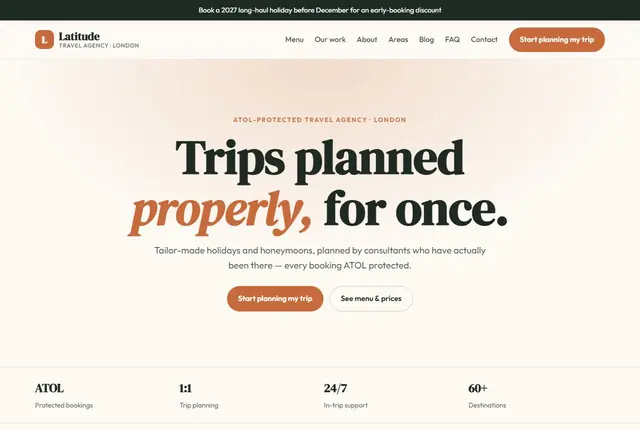
Choose your look
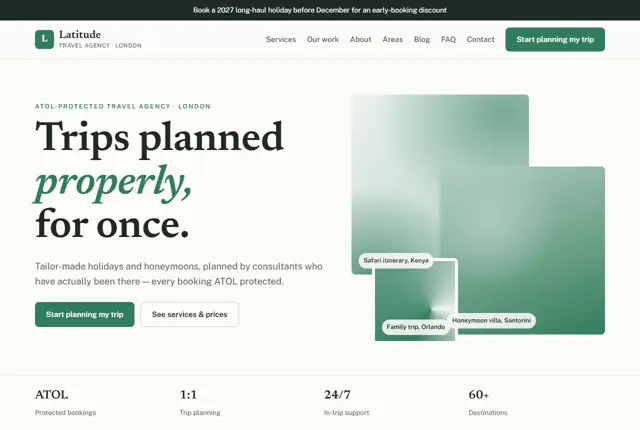
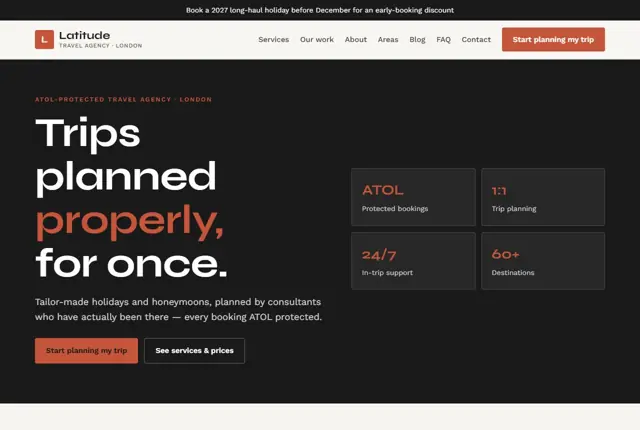
3 designs for your travel agency
Same pages and words, three different styles. Pick one — or mix parts of them — and we match it to your colours and logo.
What your customers look for
Answer these before they ask
- The kinds of trips and destinations you specialise in
- Starting prices per person, not vague ranges
- Your financial protection, explained simply
- A consultant they can actually talk to
Pages we build for you
Your travel agency website, page by page
- Home with a seasonal booking offer
- Holiday types: tailor-made, honeymoon, group
- Destinations
- Travel insurance
- Areas you serve (Growth plan)
- Start planning
FAQ, Contact and Privacy pages are free on every plan.
Free guide
How to plan a travel agency website that turns research into enquiries
Pages that help a traveller decide
Booking a holiday online is easy, so a travel agency has to show why a person is better. The site should feel like talking to someone who has actually been there. Start with pages for the kinds of trips you plan, such as honeymoons, family holidays, group travel and cruises, rather than a list of every destination on earth.
Add destination pages only for places you know well, each with the best months to go, who the place suits, typical trip length and a starting price per person. A Meet the consultants page matters here, because customers often pay a large deposit to someone they have never met. End with a Start planning page where the form asks for destination ideas and dates before anything else.
- Trip types
- Destinations you know well
- Consultants
- Protection and booking terms
- Start planning
What a nervous booker checks first
The biggest worry is money: what happens to a deposit if the airline or hotel fails, or if plans change. Answer that in plain words on its own page and link to it from the footer of every other page.
In the UK, holidays that include flights are often protected under the ATOL scheme run by the Civil Aviation Authority, and many agents also belong to ABTA. Display a licence or membership number only if you hold it, and be ready to explain how it works. In the USA a few states require sellers of travel to register, so check your state. Elsewhere, name the licence your tourism authority issued to you.
Also state what is included in a quoted price, which fees are extra, how to change a booking, and who answers the phone if something goes wrong abroad.
How people search for holidays, and how to answer
Searchers type things like “honeymoon planner for Maldives”, “family holiday Orlando travel agent near me”, “group trip to Dubai for 12 people” or “best time for safari in Kenya”. Questions put to assistants tend to be longer and more personal, such as “who can plan a two-week Japan trip for a family with a toddler?”
Write each trip page as if answering one such person. Put the trip type, region and rough budget in the first paragraph. Then give a sample itinerary day by day in short lines, what is booked for them, and what they sort out themselves.
Avoid copying hotel descriptions from supplier sites. Search engines see the duplicate, and customers learn nothing about why you chose that hotel. A sentence about which room to ask for is worth more than ten adjectives.
Seasonal demand and pricing honestly
Travel enquiries come in waves: new year planning, spring half terms, and the build-up to summer. Prepare pages and offers a few weeks before each wave, and retire them afterwards so no visitor sees an expired deal.
Show “from” prices with the conditions: per person, based on two sharing, which month, departing which airport. Currency matters, so quote in the one your customers pay in. If prices move with exchange rates or airline fares, say so once, clearly, rather than hiding it. Honest pricing pages are also the ones an assistant will quote without fear of misleading someone.
- Price per person and what it includes
- Departure airport
- Month or season of travel
- Date the price was last checked
Getting found locally as a travel agent
- Choose Travel agency as your main Google Business Profile category, and add a second one only if it truly fits.
- Add your shop or office address and opening hours, or mark yourself as a service-area business if you work from home.
- Post photos of your team, your office and real clients’ trip souvenirs shared with permission.
- Ask returning travellers for a review a few days after they get home, when the trip is fresh.
- Build a page for each town or neighbourhood you serve, mentioning nearby airports and how consultants meet clients.
- List your business in your national travel association directory and on your tourism authority’s register where one exists.
- Keep the business name, phone number and address identical everywhere it appears.
Mistakes to avoid
- Showing a wall of destinations with stock beach photos and no sign of who plans the trip.
- Burying financial protection in terms and conditions instead of explaining it in plain English.
- Quoting “from £499” with no note about the departure date, number of travellers or airport.
- Leaving last year’s offers and dates live, so visitors enquire about trips that no longer exist.
- Using a contact form that asks for passport details. Collect ideas, dates and budget first, and take sensitive data later by a proper route.
Built in for travel agencies
Features that matter in your industry
Enquiry form that asks for destination and dates first
A financial-protection explainer written in plain English
Destination pages that read like a knowledgeable consultant wrote them
Found by Google — and recommended by AI
Someone asking an assistant “tailor-made honeymoon in the Maldives from a UK agency” wants pages that name the trip type, the price range and the protection in place. Holiday-type pages here are written to be quoted that way.
Every Adyft site also ships with fast loading, structured data for search engines and a clear page for each service.
Questions
About websites for travel agencies
Can we list specific destinations?
Yes, each destination or trip type can have its own page with sample pricing.
Can the site explain our financial protection?
Yes, a clear section explains what’s protected and when, without legal jargon.
Can enquiries come straight to us?
Every enquiry form sends details to your email or WhatsApp immediately.
How much content do I need to supply for a travel agency site?
A list of the trip types you sell, a few destinations you know well and your consultants’ names and photos is enough. We write the pages around that, and you review them before launch.
Can I show different prices for different seasons?
Yes. Price tables are ordinary page text, so you can update them each season, and monthly changes are included.
Do customers need to pay a deposit through the website?
Not by default. Most agencies prefer to take the enquiry, talk to the customer, and send a booking link or invoice themselves. A payment add-on is possible if you want to take deposits online.
Should I include my financial protection or licence numbers?
Show them if you hold them, and only the ones you hold. Check the exact wording with your trade body or regulator, since some schemes have rules on how logos and numbers are used.
Can I add a blog about destinations?
Yes, and it helps when each post answers a real question, such as when to visit somewhere or how long to allow. Write from experience rather than copying brochure text.
I already have a website with an old booking engine. What happens to it?
We can link to it from a button while the new pages carry your story and enquiries. When you are ready, the enquiry form replaces it.






Your travel agency website, live this week.
Pick this design, answer a few questions on WhatsApp, and we build the rest.