Websites / Templates / Insurance brokers
An insurance broker website that earns trust before the quote
People shopping for insurance are often confused by jargon and suspicious of being sold the wrong policy. This template leads with independence — that you compare several carriers and are not tied to one — then explains each type of cover in plain language, with a free review as the first step.
From $1,499 + $69/month · live in under 7 days · we write every page for you
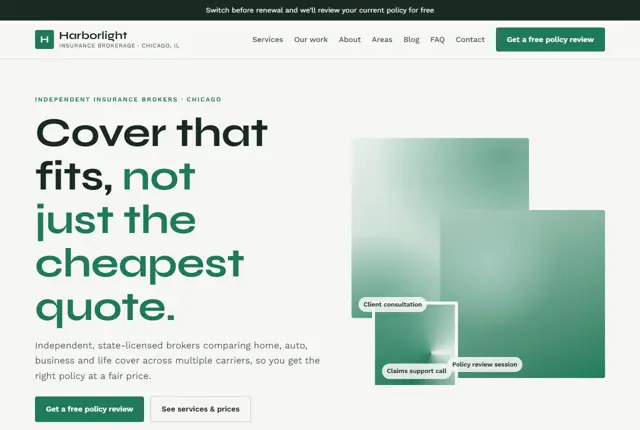
Choose your look
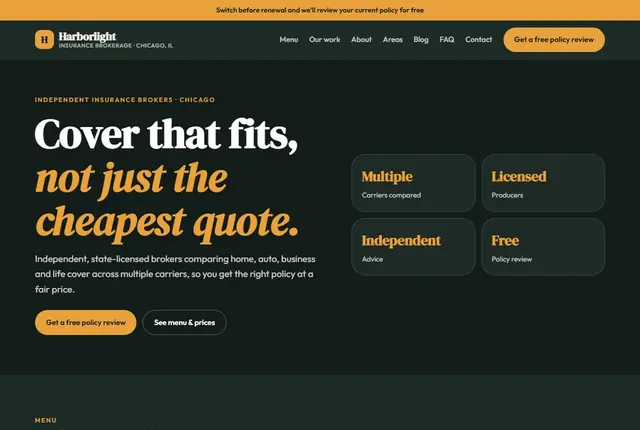
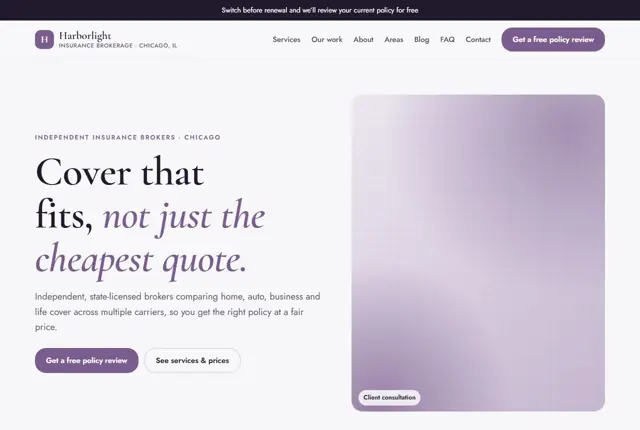
3 designs for your insurance brokerage
Same pages and words, three different styles. Pick one — or mix parts of them — and we match it to your colours and logo.
What your customers look for
Answer these before they ask
- Whether you compare more than one insurer
- What a policy actually covers, in plain language
- Licensing and how you are regulated
- How a claim actually gets handled
Pages we build for you
Your insurance brokerage website, page by page
- Home with a free policy review offer
- Cover types and quotes
- Home, auto, business and life pages (Growth plan)
- About the brokerage
- Areas served
- Claims guidance
- Get a quote
FAQ, Contact and Privacy pages are free on every plan.
Free guide
How to plan an insurance broker website that earns trust before the quote
Pages for each kind of cover
Insurance is a topic people avoid until they must act, usually at renewal or after a life event. A broker site should therefore be calm, simple and organised by situation. Create a page per cover type, such as home, motor, business, landlord, life and travel, depending on what you are authorised to arrange.
Each page explains what the cover is, what it normally includes, what it often excludes, and the questions to ask before buying. A How we work page describes your process from first call to renewal. An About page introduces the people. A Claims guidance page tells clients what to do when something goes wrong, who to call first, and how you help. The Get a review page asks for the renewal date first, which lets you time the follow-up.
- Cover type pages
- How we work
- Claims guidance
- About the team
- Renewal review request
Regulation and independence, stated carefully
This is the area where wording matters most. Brokers are regulated, and misleading claims can bring penalties. State who authorises you and show the licence or registration number. In the UK, insurance brokers are authorised by the Financial Conduct Authority and appear on its public register with a firm reference number. In the USA, brokers and agents hold licences issued by each state’s insurance department. In the UAE, insurance brokers are registered with the Central Bank of the UAE.
Use the terms “independent”, “whole of market” or “we compare several insurers” only if they accurately describe your arrangements. In the UK these phrases have specific meanings in regulation, so ask your compliance contact or network before publishing. List the insurers you place with, where you are allowed to.
Add the required disclosures, such as a complaints procedure. This is general guidance; confirm the exact wording with your regulator or compliance adviser.
How people search for insurance
Searches are a mix of price and confusion: “cheap landlord insurance UK”, “business insurance for a café”, “do I need life insurance with a mortgage”, “home insurance broker near me” and “should I bundle home and auto”. Many questions come to assistants in a worried tone after a claim, a move or a new baby.
Write cover pages in plain language, with short definitions of terms like excess, indemnity and exclusions. Answer questions honestly, including when a cheaper policy would leave a gap. Pages that explain trade-offs get quoted; pages that push a quote do not.
Add the area you serve only where it is true and relevant. Many brokers work nationally, and that is fine to say. For local trades, such as shop or contractor cover, name the towns where you know the local risks.
Explaining claims, renewals and advice without overpromising
Clients judge a broker at claim time. A Claims page should say how to report a loss, which documents help, and how your team supports the client with the insurer. Never promise that a claim will be paid, since the insurer and policy terms decide that.
Renewal is the other moment of truth. Explain that you review cover each year, not just the price, and what you will ask for. Avoid sounding like a sales funnel. Mention that premium comparisons depend on accurate information, and that missing a detail can affect a claim. This reads as responsible advice and gives an assistant something safe to quote.
- How to report a claim
- Documents to gather
- Renewal review steps
- What can affect a claim
Getting found locally as an insurance broker
- Pick Insurance broker or Insurance agency as your Google Business Profile category, depending on how you are authorised.
- Show your office address and hours, or set a service area if you meet clients remotely.
- Add real photos of the office and team so clients see who they will speak to.
- Ask satisfied clients for reviews after a claim is settled or a renewal is handled well, and reply politely to each.
- Create pages for the towns or trades you focus on, such as landlords or restaurants in a given city.
- List the firm in your national broker association directory and your regulator’s public register where applicable.
- Keep the legal name, address and phone number consistent across the site and every listing.
Mistakes to avoid
- Calling the firm independent or whole of market when it places with a restricted panel.
- Leaving out the regulator’s name and registration number, which the visitor expects to find.
- Copying policy wording from an insurer’s site, which is both duplicate content and possibly out of date.
- Promising claim outcomes or “lowest price guaranteed” which no broker can guarantee.
- Using a quote form that asks for health or financial details before the client has met anyone.
Built in for insurance brokers
Features that matter in your industry
A clear independence statement near the top of every page
Licensing details shown where clients look for reassurance
Policy review request form that asks for renewal date first
Found by Google — and recommended by AI
Someone asking an assistant “should I bundle home and auto insurance” wants a page that weighs the trade-offs honestly, not a sales pitch. Cover pages here explain what to compare, so the brokerage becomes the source an assistant can lean on.
Every Adyft site also ships with fast loading, structured data for search engines and a clear page for each service.
Questions
About websites for insurance brokers
Can the site show that we compare multiple carriers?
Yes, independence is stated on the home page and repeated on every cover page.
Can each type of cover have a page?
Home, auto, business and life each get their own page from the Growth plan up.
Can clients request a policy review?
Yes, a short form asks for their renewal date, so you can follow up at the right time.
Can I publish my licence or authorisation number on the site?
Yes, and you usually should, because clients look for it. Use exactly the details on your regulator’s register and link to the register if allowed.
Do I need a privacy policy and complaints information?
Almost certainly yes. Brokers handle personal data and are generally required to provide complaints information. Check the exact requirements with your regulator or compliance adviser.
Can clients get an online quote on the site?
The site collects a quote or review request and you follow up personally. Instant quote engines come from the insurers or your broking software, and we can link to them.
Should I name the insurers I work with?
If your agreements permit it, naming them helps clients understand the market you compare. Check any logo or brand rules before using insurers’ marks.
How do I handle sensitive information in a form?
Ask for contact details, cover type and renewal date, and take anything sensitive during a call or through your secure system.
Can I write advice articles on the site?
Yes. Short articles on topics such as what an excess is, or what to check at renewal, are useful. Keep them general and avoid personal recommendations.






Your insurance brokerage website, live this week.
Pick this design, answer a few questions on WhatsApp, and we build the rest.